
Since 1992
Print and digital marketing
PHOTO: House where Howe resided until 1846, near Readfield Corner. (Submitted Photo)
By Dale Potter-Clark
READFIELD — Readfield was home to four Maine governors – brothers Anson and Lot Morrill, Jonathan Hunton and Jonathan Hubbard. Another Readfield resident of political significance was Timothy O. Howe.
Howe was born in 1816 at Brettun’s Mills, Livermore, the same year as Elihu Washburn, whose home was the nearby “Norlands.” They attended Kents Hill School together, then Washburn studied law at Harvard before moving to Illinois. There, he became a U.S. congressman and friend to Abraham Lincoln and Ulysses S. Grant. One must assume, given their career paths, that Howe and Washburn stayed in communication.
Howe studied law in Readfield under Judge Edward Fuller at the same time as Lot Morrill, of Belgrade. They both passed the Maine var in 1839 and became law partners.
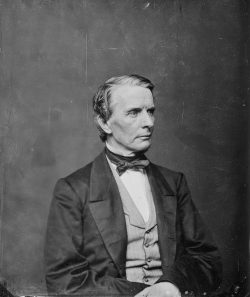
In 1846 Howe moved his family to Wisconsin, reportedly for health reasons. One must wonder if he had heard from Elihu Washburn that his brother Cadwallader had been living there for four years and prospering. Within two years of his move, Howe made unsuccessful bids for U.S. congress and lieutenant governor while continuing a law practice. He attended his party’s political convention in 1850 and was described as having “great personal popularity, worth and ability.” The following year he was appointed to the Wisconsin Supreme Court. Howe was a Whig until 1854, when he joined the new Republican Party, as did the Morrill and Washburn brothers — all were anti-slavery men.
Howe ran twice for U.S. senator from Wisconsin before winning the seat in 1861. During his 18 years as senator he supported the military draft, emancipation, Reconstruction and the impeachment of President Andrew Johnson. In 1867 he served on the first U.S. Appropriations Committee with Morrill, by then a U.S. senator from Maine. In the late 1870s, Howe was appointed commissioner to buy the Black Hills from the Sioux. In retrospect, this was not one of his finest hours. President Grant had offered Howe both the ambassadorship to Great Britain and chief justice of the U.S. Supreme Court, but, true to his party, he declined for fear a Democrat would replace him. Howe lost his Senate race in 1879.
In 1881 Howe lived in France for six months while serving on the International Monetary Commission. His wife died in Washington D.C. during that time. Upon his return home, President Chester Arthur appointed Howe the 32nd U.S. postmaster general. He served until 1883, when he died in Wisconsin at the home of a beloved nephew.
— Dale Potter-Clark researches and writes about Maine history. Two of her books are “Founders and Evolution of Summer Resorts and Kids’ Camps on Four Lakes in Central Maine” and “The Paupers and the Poor Farms.”


