
Since 1992
Print and digital marketing
READFIELD — Eighty members of the American Chestnut Foundation visited Readfield on Oct. 7 to see one of the larger American chestnut trees known to exist in Maine. Discovered last year on private property, the tree is in the historic Factory Square section of town.
Attending the Readfield tree visit were ACF members from 19 states, including Alabama, Michigan and Ohio. The foundation was formed in 1983 to help find ways to preserve American chestnuts, many of which were decimated by blight in the first half of the 20th century. The group was bused from South Portland, where they had attended their 34th annual meeting and national conference the day before. They also visited trees in Vienna and East Winthrop.
The Readfield American chestnut towers over other species surrounding it at 82 feet tall. Its circumference at the base is 69 inches. But it’s not the largest one in Maine. As of 2015 the largest American chestnut on record in Maine was in Orono. According to Jan Santerre, coordinator of the big tree registry for Maine Forest Service, the Orono tree is 78 feet and 128 inches in circumference.
Santerre said the Orono tree’s health is poor, but it’s still the champion unless it’s dead. Another tree, in Atkinson, which is 71 feet tall and 115 inches in circumference is next in line. In Lovell a 115 foot tall American chestnut, thought to be 100 years old, was discovered in 2016, but the circumference of that tree is only 50.25 inches.
The largest trees are determined through a calculation called the total point value, according to Santerre, which includes height, circumference and crown spread. Brian Roth, of the American Chestnut Foundation Maine chapter, said, the Readfield tree “is kind of in the middle as far as size of the surviving trees around the state.” Until the early 20th century, American chestnuts covered a quarter of the hardwood forests in the eastern U.S. from Maine to Georgia, and west to the Ohio River Valley. Referred to as “the redwood of the East,” it was not unusual for them to grow 100 feet tall and five feet across at the base. They provided a valuable economic resource in timber and nuts, as well as a food source for wildlife.
In the early 20th century, an Asiatic chestnut blight made its way into the U.S., and by 1950 it had decimated approximately four billion trees. In 1983, a group of scientists and laymen formed American Chestnut Foundation and initiated a breeding program to produce blight-resistant trees. Jerry Bley, of the Readfield Conservation Commission, and Dale Potter-Clark, from the Readfield Historical Society, greeted the visiting ACF members at Gile Hall on Old Kents Hill Road, and they hiked to Factory Square, where Potter-Clark gave a brief history of the industry that once existed there. She also shared vintage photos that included one taken 125 to 150 years ago, of the area where the Readfield American chestnut now stands.
Tom Klak gave a talk about Readfield’s tree and of efforts being made to preserve others that survive, with an eye towards increasing the number of healthy disease-resistant American chestnuts in Maine and elsewhere. Klak, who is a board member of ACF’s Maine chapter and a professor in the Department of Environmental Studies at the University of New England, grows chestnut seedlings in his lab in Saco, for transplanting to viable locations. Visitors also found a baby American chestnut in proximity to Readfield’s large tree, “which means there has to be a mate nearby” said the experts.
Andrew Walsh, a member of the Readfield Conservation Committee, said there is another chestnut in town, but quite some distance from the one being viewed. Klak said that given the right conditions an American chestnut can be pollinated from as far away as a half mile.
The goal of the ACF, which has 13 chapters that include all six New England states, is to introduce blight-resistant American chestnuts to their original forest range within the early decades of the 21st century.
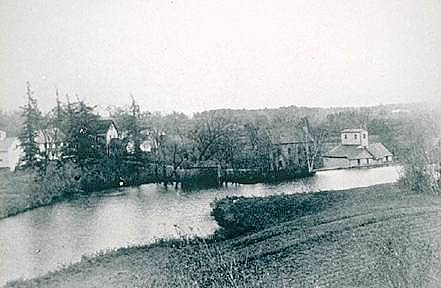
This photo, taken 125-150 years ago, depicts the area where the American chestnut and a heavy growth of other tree species exist today. In the distance is the grist mill and saw mill that once operated on Factory Square. (Submitted photo)


