
Since 1992
Print and digital marketing
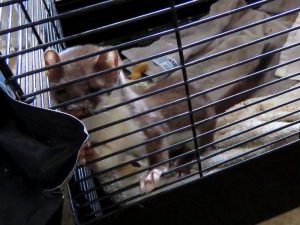
PHOTO: A weasel with an infected eye recently spent a couple days at Duck Pound Wildlife Rehab Center in Vassalboro. (Submitted photo)
By Jayne Winters
You never know what you’ll find in Don Cote’s living room at the Duck Pond Wildlife Rehab Center. When I visited him a few weeks ago to decide on a topic for this month’s article, as soon as I walked in, I knew what it would be: weasels. I’ve never seen one in the wild and feel fortunate to have arrived at Duck Pond the same day Don had one that had been captured locally.
My first question to Don was if “weasel” and “ermine” were the same critter, and he confirmed they are. I think many of us associate ermine with the fashion industry and I suppose that does sound more appealing than a “weasel coat.” The body fur changes (molts) from tan with white belly in the summer to white in the winter to provide camouflage during the change of seasons; it sports a black-tipped tail year-round. The molts are controlled by hormones that respond to the hours of daylight.
The two most common types of weasels in Maine are the long-tailed, which can grow to 11 to 22 inches long, with a tail of three to seven inches, and the short-tailed, which is typically seven to 14 inches long with a tail of two to four inches. The jury is still out on whether we also have a population of the least weasel, which, as the name suggests, is the smallest, seven to nine inches long, including tail, which does not have the black tip. Weasels are slender animals, with stubby legs and short, round ears, only weighing three to eight ounces as adults. They are relatively shy and mostly nocturnal, although they will forage during the day. Their diet mainly consists of mice, voles, shrews, rats, frogs and insects, but they are also known to kill squirrels, small rabbits, worms, snakes, birds and eggs. A weasel will eat up to two-thirds of its body weight every day because of a high metabolism (heart rates can exceed 400 beats a minute) and minimal body fat.
They live in underground burrows, often around stone walls, brush piles and old foundations for denning. Weasels are solitary except during mating season and when raising young. They are not monogamous and females care for the pups alone. The female weasel, called a jill, will have a litter of four to 10 pups in April or May after a nine-month gestation period. After nursing for a few weeks, the pups are fully independent by fall. Their life span is only four to five years; despite their ability to reach speeds up to eight miles an hour, jump to heights of six feet, and put up a good fight with their sharp teeth, they fall prey to raptors, fox and larger mammals, as well as domestic dogs and cats. In addition, weasels are subject to Maine’s two-month trapping season.
And the weasel at Duck Pond? Don said he usually gets only one or two a year to rehab and this one had been caught by a homeowner who was trying to trap squirrels. Upon examination, Don noticed one of its eyes looked infected, so after three days of treatment (always a two-person job!), it was released back into the wild.
Don continues to keep admissions and long-term residents at a limited number by transferring many rescued critters to other rehabbers who have generously offered to assist in their care.
Check these websites to see if there is a rehabber closer to you to help make critter care at Duck Pond more manageable: mainevetmed.org/wildliferehabilitation or maine.gov/ifw/fish-wildlife/wildlife/living-with-wildlife/orphaned-injured-wildlife/index.htm
— Donald Cote operates the Duck Pond Wildlife Care Center on Route 3 in Vassalboro. It is a nonprofit federal and state permitted rehab facility supported by his own resources and outside donations. Mailing address is 1787 North Belfast Ave., Vassalboro ME 04989; telephone is 207-445-4326; email is not being monitored.


