
Since 1992
Print and digital marketing
PHOTO: The 1666 Great Fire of London not only burned 80% of the city’s buildings, but also killed the rats and fleas that had caused the bubonic plague. (Photo from the cover of the book “The Great Fire of London,” by Walter George Bell)
By Vicki Schmidt
While fire can create serious situations, it has a purpose in nature and culture.
This time of year, many countries celebrate May Day, which originated as a celebration of the emergence of new life halfway between the spring equinox and summer solstice. The Beltane (bright fire) Gaelic Festival celebrates the day with huge bonfires. The residents of Nejapa, El Salvador, celebrate another force of nature with fire every Aug. 31. They commemorate the eruption of a volcano in 1922 that forced all the town’s residents to flee, tossing fireballs that represent the disaster.
 Earth is the only known planet where fire can exist. Fire burns most efficiently when oxygen is between 19 and 23%. Earth’s unique atmospheric concentration of 21% oxygen is perfect for sustaining fire. The amount of oxygen available also influences flame color. The next time you watch a campfire notice the colors – yellow indicates where oxygen is lower, while flames burning with more oxygen will burn blue.
Fire is one of the four elements — along with air, water and earth — that are essential to life on our planet. Low intensity and slow burning fires in fields and forests increase soil nutrient turnover rates, redistribute nutrients through the soil profile and increase site productivity. While extreme fire is rarely considered positive, the Great Fire of London in 1666 not only destroyed 80% of the city, but also destroyed the rats and fleas that carried the bacteria responsible for the bubonic plague, which had killed 65,000 people the previous year.
Maine celebrates Wildfire Awareness Week in April, and then in May commemorates National Wildfire Awareness Month. Lighting and lava are the only natural sources of wildfire, with all other fires directly or indirectly caused by humans and human error. During intense wildfires, trees can explode when water deep inside the tree quickly turns to steam. It’s also interesting to note that wildfire travels faster uphill than down. This is because of basic physics: heat rises and the radiant air current dries and pre-heats the grass and wood on the slope in front of the fire, causing it to burn more quickly. The fuels burn so fast, the fire appears to run uphill. Depending on the wind, uphill fires can travel many times faster than they would on flatter ground.
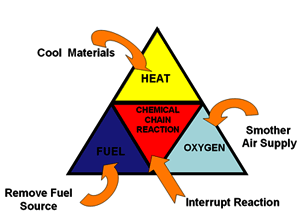
The “fire triangle” represents three items that need to come together in order for fire to exist: heat, oxygen and fuel. A fourth item, a self-sustaining chemical reaction, is needed to keep a fire burning. Modern fire science call this the “fire tetrahedron.” Once any part of the triangle is changed enough to stop the chemical reaction, such as when firefighters apply water that lowers the heat, the fire begins to decay. But if more air is added, maybe a window breaks due to glass expanding from the heat of a structure fire, the fire can flare up again. Firefighters learn how to manipulate all elements of the fire triangle, and adjust their extinguishing tactics as needed.
The potential power of fire cannot be underestimated. As a culture will fire continue to be our friendly servant, or will it turn on us as a deadly force? The answers depend on how we respect fire and more importantly, on how we understand and celebrate its virtues and how we manage its risk.
— Vicki Schmidt is a Maine state fire instructor and volunteers with the Buckfield Fire Department, as well as several regional and state fire training organizations.


