
Since 1992
Print and digital marketing
By Eriks Peterson
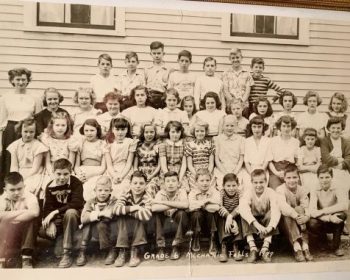
MECHANICS FALLS — The sixth grade glass in 1949 attended the other Elm Street School. Same name as the current building, but in 1949 the school was on the other side of the Elm Street.
“Between Myrtle Street and the brick house,” Marlene Pray Keene told a group of former classmates and members of the Mechanic Falls Historical Society at the society’s August meeting.
It was a two-story building with a little bell. The walkway still exists today Marlene said and “behind the school there was a field with a banking where we used to play at recess and lunch.”
Eugene said he rang the bell only once, admitting he wasn’t a bad kid, but just that, “I tried to get away with a few things.”
The Keenes were invited by the society to talk about growing up in Mechanic Falls in 1949 after they identified members of the sixth grade class photograph from that year, which was recently published as the society looked for IDs.
Eugene said students began their education at Water Street School, but at Elm Street, “You’re in the sixth grade. You’re just coming up from Water Street School. You started to get into really studying. You get a little homework now and then. They give you a bunch of words to learn for Friday’s test. . . This is the big school up on the hill. They got all these upper classmen looking down on us and saying, ‘Who are these runts?’ ”
Marlene said, “Everybody came to school with their computer, and it’s right up here,” pointing at her head. “It has many megabytes.”
She added, “So you had to use this computer to memorize your math, your spelling, reading, your social studies. It hasn’t left me. You learned by memory that seven sevens are 49, eight fives are 40, 12 times 12 equals 144. It was very organized. You had your spelling words. Every Monday they gave you ten that you had to learn to spell and define by Friday. Then you had your test. If you missed a couple then they added them over to the next week.”
You had an hour for lunch between noon and one. Mechanic Falls kids usually went home to for lunch and came back to play with their friends from Minot who attended Elm Street School as well, but had to bring a lunch.
Sometimes you went downtown to eat a half an Italian at the Grotto, a little ice cream and sandwich shop with a few tables. You could get a bag of chips and coke for a dime.
Eugene said, “I loved it after school and I loved recess because I was I guess you would have called me a jock back in them days.” He also played the snare drum in the band. There were two school bands, the high school and the elementary bands. The Memorial Day Parade was the big parade in town Eugene added.
Eugene said, “I always thought my world was Mechanic Falls . . . Mechanic Falls was the center of this area. You had the city Lewiston . . . You said you didn’t go to Lewiston, you said went to the city . . . I didn’t realize there was an Auburn until I got into high school . . . Minot and Poland, they were farming communities basically, although Poland was a recreational tourist community with all the lakes. They all came to Mechanic Falls to shop.”
In 1949, Eugene said, “There were 27 stores downtown all open,” including two shoe stores, three bars, four grocery stores, two clothing stores, a movie theater, a jeweler, and Dennings (a drug store).
“There was Royal’s Bakery. For a dollar and a half you got a quart of beans and loaf of bread on Saturday night,” he added.
Eugene said, “It’s too bad that every kid couldn’t grow up in a place like Mechanic Falls. I mean it’s a small town. People took care of the town, they took care of the schools. They took care of the kids. It was a safe town.”
There was a curfew in town. Kids 16 or younger had to be off the streets by 9 p.m., when the fire station sounded the siren. A policeman walked the beat, checking the doors to businesses after dark. The fire station was on South Main Street then and the jail was in the basement.
It was a good town back then the Keenes said. “I miss it. I remember I was fortunate enough to live at that time . . . as one man said, ‘They were the best years. ‘ ”
Marlene said, “I loved all my friends at school. . . and you went to school and did as expected. . . we were very respectful of the education system.”
The Keenes have four children, 12 grandchildren and five great-grandchildren. “I worry about the world that they have to go into today,” Eugene said.
Eugene said, “We need the youth, we need to try and come forward for them get active in the community. There are things you can do. The schools today provide a lot of things we didn’t have. We just got to encourage them the best that we can.”
“It’s the parents. The parents have got to pay attention to the kids. You can do anything you want to do. You just got to study.” And Eugene mentioned that from his small six grade class from 1949, one classmate became president of the largest paper mill in the world, another became assistant to the U.S. surgeon general, and others have achieved success as lawyers and other professions.
PHOTO: Classmates and friends 1949 Elm Street School 6th Grade Talk, top row, from left, Roger Kirk, Dorothy Marquis Bouchles, Eugene Keene, Nancy V. Conant, Bruce Conant; sitting, Barbara Trundy Durgin, Marlene Pray Keene, Ruth Pulkinen Gammon. (Submitted photo)


