
Since 1992
Print and digital marketing
By Vicki Schmidt
By the time you read this, one in seven of us has already caved on our New Years’ Resolution. Another 68 percent will hold on another week or two, and by Feb. 1, most of us will have called it quits.
But that’s OK, as your local first responders, including firefighters, emergency medical personnel, law enforcement officers, local road crews and tow-truck operators have a resolution you can start today and practice every time you get into a vehicle —simply slow down. That’s right, to heck with losing weight, learning a new language, journaling, buying more fresh flowers or traveling to new places. Bigger, faster, stronger isn’t always better and it’s proven daily on Maine roadways.
 The National Fire Protection Association, along with many other organizations, collects and reports on injury and line of duty death data. Much like other hazardous workforce statistics, for every line of duty death there are 100 injuries, and for every injury to a first responder there are an estimated 100 “near misses.”
Firefighters, along with all responders working any type of road, run the risk of being struck by a motorist. Slowing down, especially when approaching a roadway incident, helps reduce risk, helps prevent secondary accidents and in turn, helps save you and your town considerable time and money. It only takes one accident to prove to a driver how expensive losing the use of your vehicle can be. Not to mention the cost of medical injuries to you or others. When motorists approaching an incident scene do not slow down, secondary incidents are often the result. These secondary incidents not only injure or kill first responders, many times apparatus, ambulances, and other vehicles are damaged as well.
The ripple effect costs to towns and individuals can be staggering. The NFPA estimates the average cost to taxpayers for one firefighter injury is more than $95,000. Add to this the cost to a town for replacing a fire engine or ambulance, and it’s easy to see how slowing down has multiple benefits.
You may ask why firefighters bring such a big trucks to what seems like a little traffic accident. There are several reasons. One is that vehicle fires can occur very quickly at an accident and water may be needed. Additionally, not all equipment that is used to stabilize a vehicle, extricate victims, or absorb hazardous fluids are carried on every apparatus. And a most important reason — those big red trucks are excellent “blocking vehicles.” Fire apparatus are positioned to protect the accident scene, and especially the first responders working to secure the safety of victims. If another vehicle negatively impacts the accident scene, it will often be the big firetruck that absorbs the secondary accident, and hopefully keeps responders from being injured or killed.
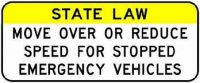
Ensuring you slow down when approaching an emergency zone is not only a New Years’ resolution you can easily succeed with, it’s also the law. Maine Title 29-A §2054-9 MRSA couldn’t be more clear: “Drivers passing a parked emergency vehicle with its emergency lights activated must pass in a lane that is not adjacent to the its emergency lights vehicle or, if doing so is unsafe or impossible, must pass at a careful and prudent speed”.
While not part of the law, if you also activate your emergency flashers it gives drivers behind you a courtesy advance warning that there’s an incident is ahead.
While weather and other conditions may reduce your ability to detect an accident and avoid firefighters and apparatus, it is unrealistic to assume the road will always be clear and unobstructed. Slowing down a bit will help keep you between the ditches and also help you avoid one of the nearly six million police-reported accidents that occur in the U.S. every year. With all the free time you save not being part of an accident, you’ll have time to learn a new language, or maybe shop for fresh flowers now and then.
— Vicki Schmidt is a Maine state fire instructor and volunteers with the Buckfield Fire Department, as well as several regional and state fire training organizations.


