Since 1992
Print and digital marketing
By John McDonald
I do a lot of traveling throughout our state and find myself bouncing down all kinds of roads in various states of repair. Some roads appear to be “almost passable.”
As I headed Down East the other day to entertain a group of conventioneers with some Maine stories, I realized every driver on the road, except for me, was talking on a cell phone. It caused me to wonder: How did people survive a road trip in those seemingly innocent days before cell phones came along? Then it hit me — Burma-Shave signs! Do you remember Burma-Shave signs?
Before going any further, I will include a few words here about the Burma-Shave phenomenon for the one or two readers – OK, maybe more — who have no idea what I’m talking about.
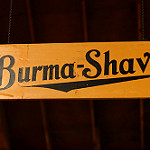
In 1925, a young man named Allan Odell told his father, Clinton Odell, who just happened to be a shaving cream maker in Minneapolis, about this great idea he had for advertising their shaving cream. Son Allan’s idea was to use small, wooden roadside signs to pitch their product, Burma-Shave, one of the country’s first “brushless” shaving creams. Dad wasn’t wild about the idea; with a name like Clinton Odell, he probably wasn’t wild about anything, if you know what I mean.
However, being a good father and wanting to give the kid something to do, Clinton gave his son $200 to give the idea a try. Soon after his first Burma Shave signs went up, sales of the shaving cream soared, in the areas where they were placed. Before long Allan and his brother Leonard were putting up signs all over the country. At first, the signs were pure sales pitches, but after a few years, the signs began showing a little of the Odell sense of humor.
They say at their height of popularity, there were 7,000 Burma-Shave signs along the highways of America. At least three or four sets of them were placed on the roads we took to our grandparents when I was a kid, a route we traveled often in those days. The familiar white on red signs — grouped by fours, fives and sixes — were as much a part of our family trip as any important cell phone call today. How could drivers not be amused, distracted and entertained by lines like: “She put a bullet/ Through his hat/ But he’s had closer/ Shaves than that/ With Burma Shave.” As a tribute to our nation’s agricultural roots, they composed gems like: “Said farmer Brown/ Who’s bald on top/ Wish I could / Rotate that crop/ Burma Shave.”
During the 1960s, in what some might consider the “beat” influence on Burma Shave, there were offerings like “Ben met Anna/ Made a hit/ Neglected beard/ Ben-Anna split/ Burma Shave.” It probably says something about our lives back then that we actually looked forward to our next encounter with a string of Burma Shave signs. Now that they’re gone, people have nothing to look forward to but their next dull cell phone call.
Some Burma Shave sayings were instructional: “He tried to cross/ As fast train neared/ Death didn’t draft him/ He volunteered/ Burma Shave.” Some dealt with historic figures: “Henry VIII sure had trouble/ Short term wives/ Long term stubble.” As much as I enjoyed the Burma Shave Road signs, I never used the product; we were a Gillette family.
I must confess to occasionally using my cell phone. Maybe we should bring back Burma Shave-type signs with different messages, such as this:
“If you drive with phone in hand / On its roof your car might land/ John McDonald.”